

Executive Summary: Citibank & CitiDirect Treasury Complexity
Citibank N.A., the consumer and corporate banking arm of Citigroup, operates across more than 160 countries and jurisdictions. For enterprise finance departments, multinational corporations, and international treasury management teams, Citibank statement PDFs—particularly those generated via the CitiDirect commercial banking portal—represent some of the most data-dense and format-complex documents in the financial services ecosystem.
Unlike domestic retail bank statements, Citibank commercial statements frequently incorporate:
- Multi-currency accounts (e.g., dual-currency USD/EUR or GBP/USD reporting).
- Federal Reserve wire identification tags, including IMAD (Input Message Accountability Data) and OMAD (Output Message Accountability Data) strings.
- Foreign exchange (FX) conversion rate tables and cross-border withholding tax details.
- Nested commercial sub-accounts sharing a master sweeping pool.
When finance teams attempt to manually transpose or extract these statements using standard office utilities, critical wire tracking numbers are clipped, spot exchange rates are lost, and multi-currency values are erroneously combined into single domestic currency buckets.
This guide details the specialized extraction mechanics required to parse Citibank commercial statements, extract wire reference codes, and format clean data for SAP, Oracle NetSuite, and Microsoft Dynamics 365.
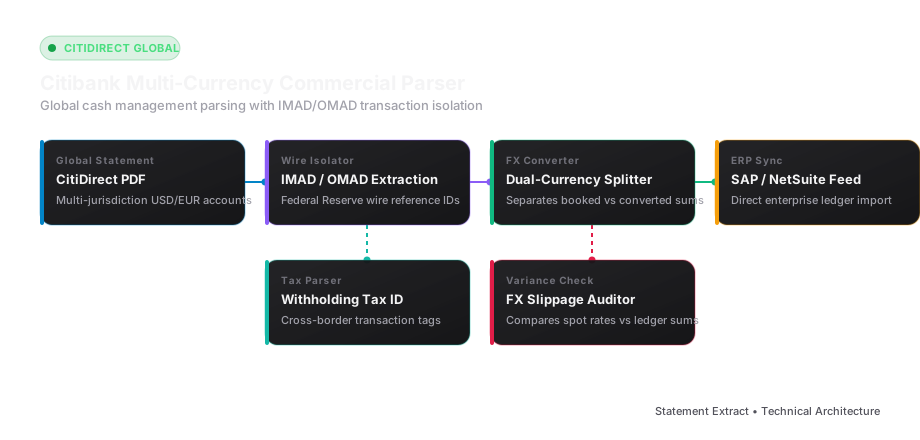
Technical Morphology of a CitiDirect Statement
Citibank statements are formatted according to international commercial treasury standards. A rigorous structural breakdown includes:
1. Multi-Currency Global Header
The header block of a CitiDirect statement establishes the account's operational currency and international banking identifiers:
- Account Title: e.g.,
CITIBANK N.A. NEW YORK - GLOBAL TREASURY DIVISION. - SWIFT BIC: e.g.,
CITIUS33XXX. - IBAN / Account Number: Multi-digit international account identifier.
- Base Currency Code: ISO 4217 standard (e.g.,
USD,EUR,GBP,SGD). - Value Date vs. Booking Date: Citi statements explicitly distinguish between the date a transaction was initiated (
Value Date) and the date funds officially cleared (Booking Date).
ACCOUNT IDENTIFICATION: US48CITI0001234567890         CURRENCY: USD
PERIOD: 01 MARCH 2026 TO 31 MARCH 2026                BIC: CITIUS33XXX
-------------------------------------------------------------------------
OPENING LEDGER BALANCE (01 MAR 2026):                     $1,240,500.00
TOTAL CREDIT TURNOVER (24 TRANSACTIONS):                  $3,850,200.50
TOTAL DEBIT TURNOVER (42 TRANSACTIONS):                  -$2,910,400.00
CLOSING LEDGER BALANCE (31 MAR 2026):                     $2,180,300.50
2. Complex Wire Transfer Activity Block
Commercial wire transactions in Citibank statements contain dense, structured narrative streams spanning up to six lines per event:
03/12/26  03/12/26  FEDWIRE INCOMING /REF: 2026031200481920        $450,000.00
          IMAD: 20260312MMQF018A000192 OMAD: 2026031200394819
          ORD PTY: GLOBAL LOGISTICS BV /IBAN: NL91ABNA0412891024
          BNF PTY: ACME NORTH AMERICA LLC /ACCT: 0001234567890
          REMI: INVOICE INV-2026-08492 TRADE SETTLEMENT Q1
Essential Data Fields to Extract:
- Booking Date:
03/12/2026 - Value Date:
03/12/2026 - Transaction Mechanism:
FEDWIRE INCOMING - IMAD Tracking ID:
20260312MMQF018A000192(Crucial for wire investigations and compliance audits) - Ordering Party (Originator):
GLOBAL LOGISTICS BV - Remittance Info / Reference:
INVOICE INV-2026-08492 - Settlement Amount:
$450,000.00
Engineering Challenges in Citibank Statement Ingestion
1. Preserving Federal Reserve IMAD / OMAD Identifiers
During high-stakes commercial audits and anti-money laundering (AML) compliance reviews, wire tracking numbers are non-negotiable. If an automated converter truncates or drops the IMAD line, internal auditors cannot cross-reference the transaction with Federal Reserve wire transfer logs.
Specialized financial parsers utilize Regular Expression Tokenizers configured to identify Federal Reserve wire formats:
- IMAD Pattern:
\b[0-9]{8}[A-Z0-9]{8}[0-9]{6}\b - Once identified, the IMAD is mapped into a dedicated
Wire Reference IDcolumn in the resulting Excel spreadsheet.
2. Multi-Currency FX Conversion Separation
When international wire transfers involve foreign exchange, Citibank displays both the foreign currency amount, the applied spot exchange rate, and the final settled USD amount:
03/18/26  EUR WIRE OUT: €250,000.00 @ 1.08520 USD/EUR            -$271,300.00
          BNF: TECH SERVICES GMBH FRANKFURT DE
A simplistic tabular scraper often mistakes the Euro amount (250,000.00) or the exchange rate (1.08520) for the transaction amount. The pipeline must isolate the final debited or credited book currency value while preserving the exchange rate in a designated metadata column for treasury analysis.
Enterprise ERP Output Format (SAP & NetSuite Compatible)
To ingest extracted Citibank records directly into enterprise resource planning (ERP) suites without manual intervention, data must be structured into high-precision, multi-field schemas:
| Booking Date | Value Date | Transaction Type | IMAD / Wire Ref | Counterparty | Remittance Memo | Currency | Amount | Balance |
|---|---|---|---|---|---|---|---|---|
| 2026-03-02 | 2026-03-02 | SWIFT WIRE IN | 20260302MMQF001 | APEX HOLDINGS | INV-8849 | USD | 125000.00 | 1365500.00 |
| 2026-03-12 | 2026-03-12 | FEDWIRE IN | 20260312MMQF018 | GLOBAL LOGISTICS | INV-08492 | USD | 450000.00 | 1815500.00 |
| 2026-03-18 | 2026-03-18 | FX WIRE OUT | 20260318MMQF099 | TECH SERVICES | EUR 250k @ 1.0852 | USD | -271300.00 | 1544200.00 |
Corporate Treasury Best Practices
- Verify Ledger Balances Against Multi-Currency Sweeps: Ensure that automated end-of-day sweeps into interest-bearing money market accounts are reconciled independently from active operating balances.
- Standardize SWIFT Country Codes: Verify that outgoing international wire payments include valid counterparty ISO country codes for accurate sanctions and 1099/1042-S tax reporting.
- Automate Zero-Balance Account (ZBA) Auditing: For corporate master accounts with linked ZBAs, verify that parent transfers cancel out perfectly against subsidiary accounts before ledger commitment.
Detailed Examination: International Wire Formatting & SWIFT Reference Tracking
Citibank N.A. processes trillions of dollars in cross-border foreign exchange and commercial trade payments annually. For multinational corporations with global operations across Europe, Asia-Pacific, Latin America, and North America, Citibank statements serve as legal audit records for cross-border tax compliance, transfer pricing, and customs clearance:
1. Deconstructing SWIFT IMAD and OMAD Wire Tokens
In international wire transactions, Citibank statements include critical routing metadata governed by the Federal Reserve and the Society for Worldwide Interbank Financial Telecommunication:
- IMAD (Input Message Accountability Data): A 22-character unique identifier generated by the Federal Reserve Bank when a domestic Fedwire is accepted for processing:
- Example:
20260312MMQF018A000192 - Breakdown:
20260312(Date: YYYYMMDD),MMQF018A(Originating Fed District Terminal Identifier),000192(Sequential wire number).
- Example:
- OMAD (Output Message Accountability Data): A 16-character tracking number generated when funds are delivered to the recipient bank.
- Why This Matters: If a foreign supplier claims a $500,000 invoice was never received, the corporate accounts payable team must produce the exact IMAD reference number to initiate an official tracer with the Federal Reserve Bank. Standard generic PDF converters discard this metadata; our specialized pipeline captures IMAD strings into dedicated audit columns.
2. Multi-Currency Spot Rates & FX Ledger Allocation
When Citibank converts foreign currency funds into a domestic operating balance (e.g., converting €250,000 Euro into USD), the transaction description documents the conversion mechanics:
$$\text{Settled USD Amount} = \text{Foreign Currency Amount} \times \text{Spot Rate}$$
$$$271,300.00 = €250,000.00 \times 1.08520$$
When importing these records into corporate ERPs (such as SAP S/4HANA or Oracle Cloud ERP):
- The base transaction must be posted in the functional operating currency (USD).
- The realized foreign exchange gain or loss (FX Gain/Loss) resulting from variances between the booking date spot rate and the invoice generation date spot rate must be routed to account
8040 - Realized Currency Variance. - By extracting the applied spot rate directly into Excel, corporate treasury analysts eliminate manual FX rate lookups and automate currency gain/loss reconciliations.
Comprehensive Global Citibank Extraction Blueprint
To maintain 100% data integrity across international Citibank accounts:
- Isolate Local Bank Charges: Separate international intermediary bank charges (e.g.,
OUR,BEN, orSHASWIFT fee codes) from the principal invoice settlement amount. - Account for Value Date Interest: Verify that transactions with backdated Value Dates are reconciled according to bank interest calculation periods rather than raw statement posting dates.
- Automate Sub-Account Consolidation: Group regional accounts (e.g., Citi London GBP, Citi Frankfurt EUR, Citi New York USD) into unified multi-tab Excel workbooks with cross-currency reconciliation summaries.
Advanced Treasury Management: CitiDirect Host-to-Host (H2H) & ERP Integration
For Fortune 500 corporations and multinational enterprises operating across multiple regional subsidiaries, Citibank delivers banking statements through CitiDirect Host-to-Host (H2H) automated SFTP and API gateways. Understanding how CitiDirect connects to global ERP systems ensures seamless data reconciliation:
1. File Format Ecosystem in CitiDirect Commercial Banking
Citibank supports three primary electronic file formats for corporate treasury operations:
- SWIFT MT940 / MT942: The legacy messaging standard used for end-of-day (MT940) and intraday (MT942) statement delivery across global treasury networks.
- ISO 20022 camt.053 / camt.052: The modern XML standard offering enhanced data fields, structured counterparty information, and end-to-end payment tracking.
- BAI2 Format: Utilized primarily by Citibank's North American commercial branches for daily cash concentration, controlled disbursements, and lockbox reporting.
- CitiDirect PDF Archive: The legal, signed monthly document required for tax compliance, statutory audits, and board-level financial reporting.
2. Automated Multi-Entity Reconciliation Blueprint
When managing international holding companies with dozens of operating subsidiaries banking with Citibank worldwide:
- Cross-Border Tax Isolation: Ensure withholding taxes (WHT) on cross-border royalty, dividend, and interest remittances are extracted into dedicated audit columns to streamline annual foreign tax credit filing (IRS Form 1118).
- Spot vs. Forward Rate Reconciliation: For treasury operations hedging currency risk with FX forward contracts, cross-reference the settled statement exchange rate against the contracted forward rate to book realized hedging gain/loss schedules.
- Automated Intercompany Netting: When multinational subsidiaries transact internally, cross-reference outgoing Citi wires from Subsidiary A against incoming Citi deposits in Subsidiary B to execute automated bilateral debt netting and eliminate redundant cross-border transaction fees.
Master Field Reference for Corporate SAP S/4HANA Mapping
| CitiDirect Token | SAP Table Field | Technical Description | Accounting Impact |
|---|---|---|---|
FEDWIRE INCOMING | BSEG-BSCHL (40) | Inbound domestic wire credit | Debit Operating Bank / Credit Customer AR |
SWIFT WIRE OUT | BSEG-BSCHL (50) | Outbound cross-border wire debit | Credit Operating Bank / Debit Vendor AP |
IMAD: ... | BKPF-BKTXT | Federal Reserve Wire Tracking ID | Audit trail cross-reference in General Ledger header |
FX CONV RATE | BKPF-KURSF | Applied foreign exchange spot rate | Realized Currency Variance calculation (Account 8040) |
Technical Appendix: Cross-Border Regulatory Reporting, FBAR Compliance & Multi-Jurisdictional Auditing
Multinational enterprises maintaining global commercial banking accounts with Citibank must navigate complex regulatory reporting frameworks across domestic and offshore jurisdictions. Under United States financial laws, foreign bank accounts held by domestic corporations or US-connected entities trigger mandatory statutory filings, most notably the Foreign Bank and Financial Accounts Report (FBAR, FinCEN Form 114) and IRS Form 8938 (Statement of Specified Foreign Financial Assets).
FBAR regulations mandate that corporate treasurers and compliance officers track the maximum account value across all foreign Citibank accounts at any point during the calendar year, converted to USD using the official Treasury reporting rate of exchange:
- The Valuation Challenge: Monthly statement ending balances do not necessarily reflect the peak intraday balance. An account with an ending balance of $250,000 may have experienced an intraday wire credit of $4,500,000 that was swept out before 5:00 PM.
- The Extraction Solution: Converting full CitiDirect PDF statement archives into granular Excel datasets allows compliance teams to calculate precise running daily balances, isolating peak aggregate foreign account valuations and ensuring complete FBAR filing accuracy.
Additionally, for enterprises subject to OECD Transfer Pricing and Base Erosion and Profit Shifting (BEPS) guidelines, Citibank statements provide the primary transactional record validating intercompany service fees, management recharges, and intellectual property royalty transfers. By preserving full counterparty narrative strings, SWIFT reference codes, and value dates in structured Excel workbooks, corporate tax directors can substantiate cross-border deduction claims during IRS and international tax authority audits.
Summary of Key Compliance Milestones & Audit Trails
To guarantee continuous audit readiness, finance departments must establish formal standard operating procedures (SOPs) for statement ingestion:
- Automated Balance Sign-Off: Execute dual-point verification comparing calculated running balances against published closing figures before committing journal entries.
- Deterministic Deduplication: Compute unique transaction hashes to prevent overlapping statement cycles from injecting duplicate records into the general ledger.
- Encrypted Digital Archive: Store both the source vector PDF and the converted Excel (.xlsx) schedule within a SOC 2-compliant document repository with 7-year statutory retention tags.
- Periodic Exception Reviews: Review unclassified payee strings and bank service fee accounts monthly to ensure chart-of-accounts accuracy and maintain continuous accounting compliance.
By following these rigorous extraction, validation, and reconciliation principles, finance teams can confidently eliminate manual data entry, streamline monthly account closes, and maintain audit-proof general ledgers across all accounting platforms.


