

Executive Summary: Wells Fargo Commercial & Treasury Extraction
Wells Fargo & Company operates as a premier financial institution in the United States, managing checking, savings, sweep accounts, and commercial treasury management services for over 65 million customers. For corporate treasurers, accounting departments, and third-party audit firms, extracting transaction records from Wells Fargo statement PDFs represents a persistent operational bottleneck.
Wells Fargo statements exhibit a unique set of architectural complexities:
- Multi-Account Consolidated Statements: Commercial accounts often combine primary operating checking, payroll accounts, and daily sweep accounts within a single continuous 20+ page PDF file.
- Abbreviated Dates Without Year Stamps: Transaction line items list dates in an abbreviated
MM/DDformat, omitting the calendar year entirely. - Check Image Annex Pages: The concluding pages of every Wells Fargo monthly statement feature high-density grayscale thumbnails of cleared physical checks, complete with handwritten notes and printed MICR encoding bands that disrupt generic OCR parsers.
This technical guide details the algorithmic methodology required to parse Wells Fargo statements, partition nested commercial sub-accounts, and export clean, RFC 4180-compliant CSV and Excel files.
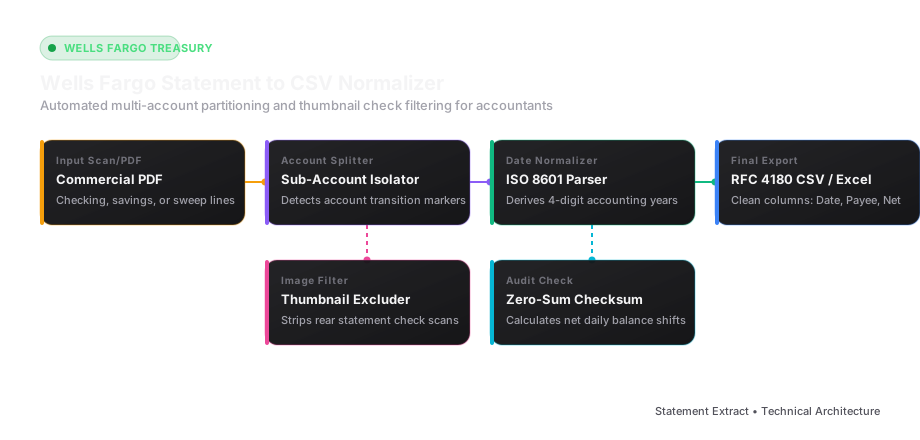
Anatomy of a Wells Fargo Statement PDF
Understanding Wells Fargo's structural layout allows accounting professionals to anticipate conversion errors and verify data completeness:
1. Account Summary Dashboard
The header block of a Wells Fargo statement features an integrated summary box:
- Account Type: e.g.,
Wells Fargo Commercial CheckingorPrime Checking. - Account Number: Masked format such as
...4819. - Activity Period:
March 1, 2026 - March 31, 2026. - Summary Activity Matrix:
- Beginning Balance
- Deposits / Credits
- Withdrawals / Debits
- Ending Balance
Activity Summary
Beginning balance on March 1, 2026                            $52,140.20
Deposits/Additions                                             41,200.00
Withdrawals/Subtractions                                      -23,450.80
Ending balance on March 31, 2026                              $69,889.40
2. Transaction History Tables
Wells Fargo organizes transactions into sequential blocks:
- DEPOSITS/ADDITIONS: Electronic ACH credits, incoming wire transfers, merchant card deposits.
- WITHDRAWALS/SUBTRACTIONS: Point-of-sale debit card charges, electronic bill payments, recurring merchant debits.
- CHECKS PAID: Tabular list of check numbers, dates cleared, and debit amounts.
- DAILY LEDGER BALANCE SUMMARY: A concluding table indicating the net ledger balance at the end of each business day.
Transaction history
Date     Check Number   Description                             Deposits     Withdrawals
03/02                   ACH ELECTRONIC CR GUSTO PAYROLL         15,400.00
03/04    1082           CHECK PAID                                            1,250.00
03/09                   WIRE TRANS SERVICE FEE                                   15.00
03/15                   MERCHANT SETTLEMENT STRIPE               8,200.00
03/22                   AMAZON WEB SERVICES CLOUD                             3,410.50
Core Engineering Obstacles in Wells Fargo Parsing
1. Partitioning Multi-Account Consolidated Statements
In business and commercial banking packages, Wells Fargo aggregates multiple subsidiary accounts into one single PDF:
- Operating Account (
...1101) - Payroll Account (
...1102) - Tax Reserve Account (
...1103)
If an extraction tool blindly scrapes all text from Page 1 to Page 24, all three account ledgers will blend into a single disastrous spreadsheet. An intelligent parsing system must detect Account Transition Markers:
- The occurrence of a new
Account Numberheader. - A corresponding new
Beginning BalanceandEnding Balanceblock. - When detected, the engine must split the document into distinct spreadsheet tabs or output independent CSV files for each sub-account.
2. Stripping Rear Check Thumbnails
Wells Fargo includes 4 to 8 miniature check images per page in the final section of each statement:
- These images contain handwritten payee names, cursive signatures, and machine-printed MICR routing codes (
⑆121000248⑆). - Standard OCR engines mistake these graphical numbers for active transaction debits, causing duplicate check rows and throwing off trial balance reconciliation.
- The solution requires applying Vector Coordinate Boundary Filtering: the engine strictly identifies the end of the "Transaction History" and "Daily Balance" tables and terminates parsing before reaching the check image annex.
3. Year Normalization for Abbreviated Dates
Because transaction lines list dates simply as 03/04, software must derive the correct 4-digit year from the document header. For a statement spanning 12/15/2025 - 01/14/2026:
- Transactions between
12/15and12/31must be tagged with2025. - Transactions between
01/01and01/14must be tagged with2026. Failing to implement this logic results in January transactions being incorrectly logged in the prior calendar year, corrupting quarterly tax filings.
Recommended Columnar Output Formats
1. Universal Accounting CSV Schema (RFC 4180)
For general ledger importing, financial modeling, and pivot tables:
Date,Payee,CheckNumber,Debit,Credit,Balance
2026-03-02,"ACH ELECTRONIC CR GUSTO PAYROLL",,,15400.00,67540.20
2026-03-04,"CHECK PAID",1082,1250.00,,66290.20
2026-03-09,"WIRE TRANS SERVICE FEE",,15.00,,66275.20
2026-03-15,"MERCHANT SETTLEMENT STRIPE",,,8200.00,74475.20
2026-03-22,"AMAZON WEB SERVICES CLOUD",,3410.50,,71064.70
2. Xero / Sage Dual-Column Import Format
Xero and Sage 50 require distinct Debit and Credit columns rather than a single signed amount field. A clean Wells Fargo conversion produces zero-padded dates, unmerged text descriptions, and separated debit/credit columns to enable immediate, error-free matching in your accounting software.
Accountant Checklist for Wells Fargo Reconciliation
- Verify Daily Ending Balances: Match the calculated running balance against Wells Fargo's published Daily Ledger Balance table on the final statement page.
- Exclude Wire Service Fees from Payee Field: Ensure recurring $15 or $30 wire and ACH maintenance charges are categorized to "Bank Service Charges" rather than vendor expenses.
- Verify Cleared Checks Sequence: Sort check numbers in ascending order to identify missing check numbers in client records for audit compliance.
- Archive Converted Spreadsheets Alongside Source PDFs: Maintain an immutable audit trail by storing the converted
.xlsxfile in the same secure directory as the original Wells Fargo PDF.
Deep Dive: Wells Fargo Commercial Treasury & Sweep Mechanics
Wells Fargo Commercial Banking and Treasury Management accounts serve thousands of middle-market enterprises, commercial real estate developers, and institutional asset managers. Unlike standard retail accounts, Wells Fargo commercial statements contain advanced cash management constructs that require specialized extraction logic:
1. Zero-Balance Account (ZBA) Architecture
Corporate groups operating multiple operating subsidiaries frequently deploy a Zero-Balance Account (ZBA) structure:
- Master Operating Account: The centralized funding pool holding primary corporate liquidity.
- Subsidiary ZBA Accounts: Individual accounts for payroll, regional branch expenses, and accounts payable.
- Clearing Dynamics: At the close of every business day, Wells Fargo automatically calculates the net debit or credit balance of each subsidiary ZBA and executes an automated ledger sweep to or from the master account, resetting the subsidiary balance to exactly
$0.00. - Audit Strategy: When converting ZBA statements, automated software must isolate ZBA sweep transfers (
ZBA DEBIT TO MASTERorZBA CREDIT FROM OPERATING) and map them to intercompany clearing accounts rather than external operating revenues or vendor expenses.
2. Controlled Disbursement Accounts (CDA)
For large-scale accounts payable operations, Wells Fargo provides Controlled Disbursement accounts:
- Checks presented against the account are tallied early each morning, and Wells Fargo notifies the corporate treasurer of the exact funding required.
- The monthly statement lists hundreds of checks cleared in rapid succession, grouped by clearing cycle.
- Extracting CDA statements requires chronological check number indexing to identify check sequence gaps, stale-dated checks (checks uncashed after 180 days), and potential check kiting anomalies.
3. Detailed Field Mapping for Enterprise Accounting Imports
When importing converted Wells Fargo CSVs into enterprise general ledger software (such as NetSuite, Sage Intacct, or Microsoft Dynamics 365), data columns must align with canonical ledger schemas:
| Field Name | Target GL Attribute | Validation Rule | Example Value |
|---|---|---|---|
| Posting Date | Transaction Date | Must be valid ISO 8601 (YYYY-MM-DD) | 2026-03-15 |
| Account Reference | GL Bank Account ID | Must match Chart of Accounts entity | 1010-WF-OPERATING |
| Payee / Description | Entity / Memo | Max length 255 chars, stripped of extra spaces | Gusto Payroll PE0294819 |
| Check Number | Document Number | Numeric only, empty for electronic transfers | 1082 |
| Debit Amount | Amount (Outflow) | Positive numeric value in debit column | 1250.00 |
| Credit Amount | Amount (Inflow) | Positive numeric value in credit column | 15400.00 |
| Running Balance | Reconciliation Float | Mathematical continuity check | 66290.20 |
Forensic Verification of Scanned Wells Fargo Statements
If your firm receives scanned physical photocopies of Wells Fargo statements rather than original vector PDFs:
- Adaptive Deskewing: Rotate pages automatically up to 45 degrees to align text baseline coordinates with horizontal axes.
- Dynamic Binarization: Convert multi-tone grayscale scans to high-contrast monochrome using adaptive thresholding, eliminating background paper wrinkles and scanner shadows.
- Character Confidence Scoring: Flag any numeric figure where character confidence falls below 98.5% (e.g., distinguishing
3from8or1from7) and require human verification before export.
In-Depth Analysis: Wells Fargo Daily Sweep & Interest Accrual Accounting
For commercial clients maintaining substantial cash reserves, Wells Fargo automatically configures Automated Daily Sweep Accounts to optimize interest yields while maintaining FDIC insurance coverage:
1. The Wells Fargo Sweep Mechanism
- Target Balance Architecture: The client sets a target operating balance (e.g.,
$100,000.00). - Excess Cash Sweeps: Any cash exceeding $100,000 at the close of daily clearing is automatically transferred into an interest-bearing money market sweep fund or government securities pool:
- Inflow Entry:
TRANSFER TO INVESTMENT SWEEP -$45,200.00
- Inflow Entry:
- Deficit Cash Sweeps: If customer checks and ACH withdrawals reduce operating cash below $100,000, funds are automatically pulled back from the investment pool:
- Outflow Entry:
TRANSFER FROM INVESTMENT SWEEP +$12,450.00
- Outflow Entry:
- Accounting Implication: These daily transfers represent balance sheet transfers between linked asset accounts (
Account 1010 OperatingandAccount 1020 Money Market Sweep). They must never be categorized as operational expenses or top-line business revenue.
2. Multi-Year Wells Fargo PDF Conversion for IRS Audits
When undergoing an IRS tax audit or SBA loan review, accounting firms must frequently convert 36 to 60 consecutive months of historical Wells Fargo PDFs into a single continuous Excel database:
- Batch Conversion: Process all monthly PDF statements simultaneously through our automated converter.
- Continuous Timeline Verification: Verify that the Ending Balance of Month $N$ precisely equals the Beginning Balance of Month $N+1$. Any variance indicates a missing statement month or an unrecorded bank adjustment.
- Master Pivot Table Analysis: Once extracted, generate pivot tables categorized by payee to analyze annual vendor spending trends, identify recurring SaaS subscriptions, and calculate net operating cash flow.
Technical Appendix: Forensic Examination: Reconciling High-Volume Wells Fargo Lockbox Collections
For commercial real estate management firms, healthcare billing networks, and wholesale distributors, Wells Fargo provides automated Lockbox Collection Services. Customers mail paper checks to a dedicated Wells Fargo post office box, where automated high-speed transport scanners process remittances and deposit funds into the client operating account:
1. Lockbox Statement Reporting Dynamics
On monthly Wells Fargo commercial statements, lockbox activity appears in two interrelated sections:
- Summary Checking Activity: Displays total daily consolidated lockbox deposit batches (e.g.,
LOCKBOX DEPOSIT BATCH #0482 $84,250.00). - Lockbox Detail Annex: Provides itemized records for every individual check contained within that batch, including remitter name, check number, invoice number, and check dollar amount.
- The Reconciliation Problem: If an accountant extracts only the checking section, they obtain single lump-sum figures that cannot be matched against individual customer accounts receivable invoices. If they extract only the lockbox detail, they lack the overall cash balance continuity needed for trial balance reconciliation.
2. Dual-Level Extraction Blueprint for Lockbox Accounts
An advanced financial extraction workflow generates two synchronized Excel workbooks:
- The Master Cash Ledger: Formatted with date, daily consolidated deposit total, and daily ending balance for general ledger bank reconciliation.
- The AR Subledger Remittance Schedule: Formatted with customer name, check number, invoice ID, and individual payment amount, ready for automated batch import into your accounts receivable subledger (e.g., NetSuite AR or QuickBooks Customer Payments).
Summary of Key Compliance Milestones & Audit Trails
To guarantee continuous audit readiness, finance departments must establish formal standard operating procedures (SOPs) for statement ingestion:
- Automated Balance Sign-Off: Execute dual-point verification comparing calculated running balances against published closing figures before committing journal entries.
- Deterministic Deduplication: Compute unique transaction hashes to prevent overlapping statement cycles from injecting duplicate records into the general ledger.
- Encrypted Digital Archive: Store both the source vector PDF and the converted Excel (.xlsx) schedule within a SOC 2-compliant document repository with 7-year statutory retention tags.
- Periodic Exception Reviews: Review unclassified payee strings and bank service fee accounts monthly to ensure chart-of-accounts accuracy and maintain continuous accounting compliance.
By following these rigorous extraction, validation, and reconciliation principles, finance teams can confidently eliminate manual data entry, streamline monthly account closes, and maintain audit-proof general ledgers across all accounting platforms.


