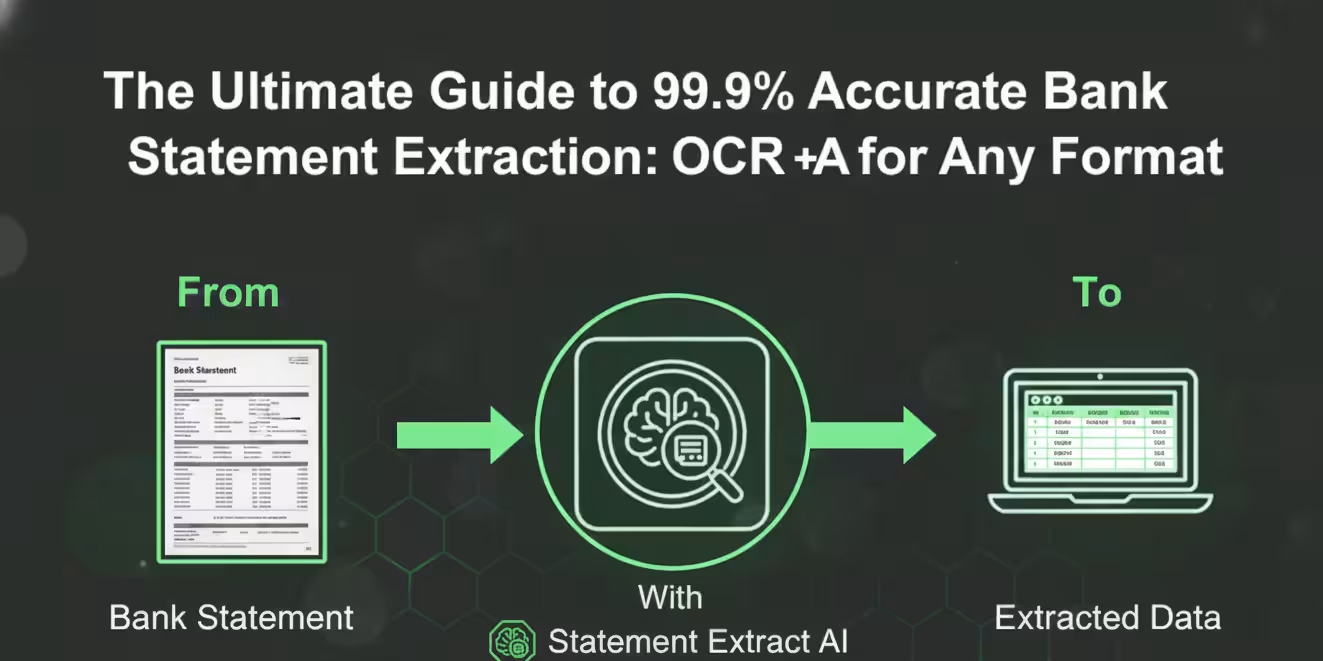
The Ultimate Guide to 99.9% Accurate Bank Statement Extraction: Why Contextual AI Beats Templates and LLMs (A Financial Analyst's View)
Every professional in lending, accounting, or FinTech knows the drill: the bank statement is the single most critical document in the financial world. It’s the source of truth for solvency checks, loan decisions, and compliance.
But let's be honest—it's also the single biggest headache.
You get PDFs, low-res scans, and jpegs from dozens of banks globally. Each document has a different layout, font, and table structure. Trying to extract reliable data is often where the entire automation pipeline grinds to a halt.
The goal is simple: Extract every key transaction and detail with virtually 100% accuracy, instantly, without the costly, never-ending process of building new templates.
This isn't a future vision; it's what we built Statement Extract to do. We're delivering 99.9% financial data integrity out-of-the-box. We took the problem seriously and eliminated the need for manual checks, brittle templates, and the anxiety of relying on unverified data.
In this comprehensive guide, we'll peel back the curtain. We'll show you exactly how our technology validates data like an experienced financial analyst, why it's superior to legacy systems, and how to start automating your most critical financial processes today.
1. The Critical Flaws of Old-School Document Extraction
If you've spent months battling legacy OCR solutions, you know this pain point intimately. The existing landscape is dominated by two methods that simply weren't built for the dynamic nature of finance:
1.1. The Crushing Weight of Template-Based Systems and Technical Debt
Picture this: You spend two weeks painstakingly mapping the coordinates for a Bank of America statement. It works perfectly... until Bank of America pushes a minor PDF update, moves their logo, or changes the font size. Boom. The whole template breaks.
- The Problem is the "Where," Not the "What": Template-based systems are fixated on where the data sits (coordinates or rigid visual patterns). Since bank statements are inherently non-standard, maintaining a library of thousands of these fragile templates—one for every permutation—becomes a crippling source of technical debt. You are constantly playing catch-up with every bank's design department. Every new regional bank you onboard demands another two days of template configuration and testing. This is not scale.
- The Hidden Cost of Exception Handling: When a template fails, the document is routed to a human operator for a manual check and data entry. We’ve seen this manual exception handling account for over half of the total processing cost for some organizations. It kills your speed and your profitability, especially in high-volume, time-sensitive areas like loan processing. The moment a document leaves your automation workflow and lands on a human's desk, you lose both time and the chain of verifiable data.
1.2. The Alluring but Risky Promise of Generic LLMs in Finance
The advent of Large Language Models (LLMs)—like a general-purpose AI chatbot—is exciting, but they’re dangerous when dealing with high-stakes financial data. While they understand language incredibly well, they fundamentally lack the necessary precision and integrity checks required for compliance.
- Not Dedicated OCR Engines, Just Smart Guessers: LLMs cannot reliably process low-quality scans. They don't have the robust image correction algorithms of industrial-grade OCR. They might guess a blurry number "6" is an "8," and because they prioritize contextual flow over numerical fidelity, they proceed without flagging the error.
- The Danger of Financial Hallucination is Real: This is the biggest risk. LLMs are trained to sound plausible. If the AI is unsure about a number or a date, it might fabricate a plausible transaction amount or fill a gap with estimated data to complete the text. Plausibility is fine for creative writing; it’s a compliance catastrophe for finance. Imagine a loan applicant's debt being understated by 10% because an LLM "guessed" the ending balance.
- Ignoring the Audit Trail: LLMs provide an output, but they don't natively perform the crucial cross-checks (like balance verification). Your audit team requires a clear chain of custody and verifiable proof that the numbers are correct. A general AI cannot provide that level of audit-ready data integrity.
You need an engine that is both a precise surgeon (OCR) and a meticulous accountant (AI), not just a talented conversationalist.
2. The Statement Extract Difference: Verified Contextual AI for 99.9% Accuracy
How do we solve the reliability problem and guarantee that game-changing 99.9% accuracy? We don't rely on simple templates or generic models. We combine industrial-grade OCR with a specialized, financial-focused AI layer that understands context, data relationships, and financial logic.
Comparison of Document Extraction Approaches
To underscore the differences, here is a quick comparison of the three primary methods for bank statement data extraction:
| Extraction Method | Primary Focus | Setup Requirement | Data Validation | Risk of Error |
|---|---|---|---|---|
| Template-Based OCR | Fixed Coordinates | High (Template mapping per format) | Basic (Character level only) | High (Breaks on layout change) |
| Generic LLM | Language Context | Minimal (Prompt Engineering) | None (Relies on Plausibility) | Critical (Risk of Hallucination) |
| Statement Extract AI | Financial Context & Structure | Zero (No Templates) | Automated Reconciliation Check | Extremely Low (99.9% Integrity) |
2.1. It Starts with Vision, Not Just Text Recognition
Our process isn't just about reading characters; it's about interpreting the document's structure, just like a seasoned human analyst does.
- Intelligent Layout Mapping: The core of our OCR component is the vision engine. This engine uses advanced deep learning to visually interpret the document structure. It knows that the list of numbers in the bottom-right corner usually relates to the summary balances, regardless of if it's Chase, HSBC, or a local credit union. It understands the visual hierarchy, not just the text content.
- Advanced Table Extraction (Tableformers): Complex financial documents often contain tables where the lines and cells are subtle or completely removed (a common feature in digital PDFs). Our specialized Tableformer models identify these latent table structures, correctly associating the correct Date, Description, and Amount, even if the transaction description wraps onto three separate lines, ensuring transaction completeness.
- Handling Real-World Scans: Before any text is read, advanced image pre-processing algorithms kick in. These features normalize low-resolution images, correct for common camera skew and perspective distortion, and filter out artifacts like watermarks, coffee stains, or background noise, ensuring high character accuracy (a necessity for reliable numbers).
2.2. The Linchpin: Contextual Understanding and Validation
This is where Statement Extract completely separates itself from the competition. Our AI doesn't just extract text; it applies financial logic and semantic understanding—the two pillars of verified extraction.
-
Semantic Mapping (The No-Template Secret): Our proprietary AI model is pre-trained on millions of statements and financial document variations globally. It understands that "CLOSING BALANCE," "FINAL LEDGER," and even local regulatory jargon all refer to the exact same concept. This deep, contextual learning is why you have zero setup when dealing with a new bank format—the AI already understands the concept, not the coordinates.
-
Continuous Multi-Page Context: Critically, the AI maintains context across a document that might span five, ten, or thirty pages. It accurately and automatically links the closing balance of Page N to the opening balance of Page N+1, and correctly attributes transactions that are split across page breaks.
-
The 99.9% Guarantee: Automated Reconciliation Check This final step ensures the data is not just present, but financially sound. Before the data leaves our secure pipeline, the AI performs the fundamental financial reconciliation check:
$$\text{Opening Balance} + \sum \text{Credits} - \sum \text{Debits} = \text{Closing Balance}$$
If the extracted numbers fail this equation by even a penny, the specific document is flagged for enhanced review. This automated, mathematical validation process is how we virtually eliminate numerical errors and confidently guarantee financial data integrity. You can’t cheat the math. This is what makes the data audit-ready.
- Automated Bookkeeping: Stop manually keying in transactions. If you're still relying on rudimentary tools, learn why your team should stop wasting time on manual PDF conversion and adopt an AI solution instead.
3. Game-Changing Use Cases: Driving ROI in Finance
A high-accuracy, no-template AI isn't just a cost-saver; it’s a revenue accelerator and a compliance safeguard.
Key Data Fields Extracted for Financial Automation
Statement Extract ensures you receive all critical data points required for regulatory reporting, lending, and accounting:
| Data Category | Key Fields Extracted | Use Case Relevance |
|---|---|---|
| Account Metadata | Account Holder Name, IBAN/Account Number, Bank ID, Statement Period | KYC/KYB Verification, Account Linking |
| Summary Balances | Opening Balance, Closing Balance, Total Credits, Total Debits, Currency | Solvency Assessment, Cash Flow Analysis |
| Transaction Line Items | Date, Description (Payee/Payer), Credit Amount, Debit Amount, Running Balance | Automated Reconciliation, Risk Modeling |
3.1. FinTech and Lending: Accelerating Underwriting Decisions
In the lending world, time is money. Statement Extract enables true lending automation by making the document review phase instant and trustworthy:
- Rapid Income and Expense Verification: Imagine instantly extracting recurring salary deposits, rent payments, and utility expenses. This allows for the immediate, automated calculation of precise Debt-to-Income (DTI) and Debt-Service Coverage (DSC) ratios, cutting down application review time from days to minutes. This speed is a huge competitive advantage for securing quality loan applicants.
- Risk Modeling Data Feed: Your AI risk models are only as good as the data you feed them. By providing clean, normalized transaction history from our validated pipeline, you ensure the models are trained on reliable data, not manually-inputted errors.
- Advanced Fraud Detection: Our system can quickly detect subtle inconsistencies—such as a large transaction amount that appears to be manually inserted, or a final balance that doesn't reconcile. This sophisticated layer of checks significantly strengthens your internal financial fraud detection protocols, protecting your firm from financial loss.
3.2. Accounting, Bookkeeping, and ERP Integration
Accounting firms and internal finance departments spend countless hours battling manual bank reconciliation, especially across disparate client or regional accounts.
- Automated Bookkeeping: Stop manually keying in transactions. Our system allows you to automatically convert thousands of PDF bank statements into structured data that is instantly importable into major systems like QuickBooks, Xero, SAP, or your custom ERP.
- Significant Acceleration of Month-End Close: By automating the data entry and providing pre-validated output, financial teams can shift their focus entirely to analysis, variance reporting, and high-value strategic tasks. This directly leads to a significant reduction in the financial month-end close cycle time.
- Compliance and Audit Readiness: The verified nature of the extracted data means you always maintain a clean, verifiable audit trail. The data is inherently compliant because it has been mathematically checked by the AI, significantly reducing the burden during external audits.
4. Best Practices for Input Documents: Maximizing AI Accuracy
While Statement Extract’s AI is robust enough to handle the majority of real-world documents, following these best practices will guarantee the fastest, highest-accuracy results:
- Prioritize Digital PDFs: Whenever possible, use a native digital PDF, as the text data is embedded and 100% accurate.
- Use High-Resolution Scans: If you must use a physical copy, scan the document at a minimum of 300 DPI (dots per inch). This ensures the OCR engine can accurately capture small font details and numbers.
- Avoid Excessive Annotations: While the AI can filter out background noise, heavily marked or handwritten notes over key transaction areas can slightly degrade accuracy.
- Ensure Complete Pages: Make sure the header (account details) and footer (summary balances) are fully visible in the scan, as these sections contain the critical data needed for the final reconciliation check.
5. Integrating Statement Extract: A Developer’s Guide to Automation
Implementing the solution should be as fast as the extraction itself. We prioritize ease of integration for rapid deployment and immediate ROI.
5.1. The Statement Extract REST API
Our Bank Statement Extraction API is built on modern, lightweight principles, making it easy to integrate into any existing system or programming language (Python, Node.js, Java, etc.):
- Asynchronous Processing Flow: For large files, you simply upload your document via a
POSTrequest, receive an immediate job ID, and then poll the endpoint for the final structured JSON output. This robust asynchronous flow is essential for handling batch processing of hundreds of large bank statements without timing out your main application. - Flexible Output Schemas: The output is not fixed. You can define the schema to include only the fields your specific application needs (e.g., exclude running balance if your ERP calculates it internally), reducing data overhead.
5.2. Seamless Workflow Automation and Direct DB Writes
- Real-Time Data with Webhooks: This is the developer's choice for true, low-latency automation. Configure a callback URL in our dashboard. The moment a document is fully processed and mathematically validated (Stage 3 complete), we send a secure, real-time notification containing the clean JSON payload directly to your application. This triggers immediate downstream processes, like updating a lending dashboard or queuing a reconciliation task.
- Direct Database (Direct DB) Integration: This is a game-changer for reducing complexity. Why write custom scripts to move data from a webhook payload into your data warehouse? We offer a unique feature that lets you configure Statement Extract to write clean, structured data directly into your SQL or NoSQL database tables. This eliminates unnecessary middleware and is perfect for maintaining a clean, centralized data lake for financial documents.
6. Conclusion: The Future of Financial Document Processing is Verified AI
The era of template-based financial data extraction is over. To remain competitive in lending, accounting, and FinTech, organizations must adopt solutions that guarantee accuracy, scale effortlessly, and demand zero ongoing maintenance.
Statement Extract’s Contextual AI is the definitive answer. We deliver the 99.9% data integrity required for audit-ready, automated financial workflows. Stop losing valuable time and money on manual data entry and exception handling.
Your competitive advantage is just a few clicks away.
Try StatementExtract for Free Today
Frequently Asked Questions
01. What is Statement Extract and how is it different from generic OCR tools?
Statement Extract is an AI-powered document intelligence platform designed to transform complex, unstructured documents (like bank statements, invoices, and contracts) into clean, structured data.
- Difference: Generic OCR only reads text; Statement Extract uses Intelligent OCR + Contextual AI. This means we don't rely on fragile templates. Our AI understands the financial context and relationships within the data, leading to 99.9% accuracy and a crucial feature: automated data integrity validation.
02. What is the claimed 99.9% accuracy, and how do you achieve it?
The 99.9% accuracy refers to financial data integrity, not just character recognition. We achieve this through our patented three-stage pipeline:
- Intelligent OCR: High-precision character recognition, even on low-quality scans.
- Contextual AI Parsing: Semantic mapping that understands financial terms and table layouts.
- Automated Validation: The AI performs a mathematical reconciliation check (e.g., verifying that deposits + opening balance = closing balance) before the data is finalized. This step eliminates numerical errors before the data reaches your system.
03. Do I need templates or training data to get started?
Absolutely not. This is our core differentiator. Statement Extract’s AI is pre-trained on millions of bank statements and financial documents from banks globally. Our system understands the concept and context of financial fields, not just their fixed position. You can upload any bank statement format, and the system works instantly.
04. How fast is the processing, and can it handle large volumes of documents?
Our pipeline is built for enterprise scale. We can process thousands of documents per minute with consistent accuracy. Since our system eliminates template maintenance and manual exceptions, your effective throughput is much higher than solutions relying on human-in-the-loop validation.
05. How can I integrate Statement Extract into my existing systems?
We offer robust, flexible integration options for developers and process owners:
- REST API: Simple HTTP endpoints for seamless communication with any platform.
- Webhooks: Real-time push notifications that send validated data to your application instantly upon completion.
- Direct DB Integration: Write clean, structured data directly into your SQL or NoSQL database tables.
- Cloud Storage: Integration with S3, GCS, and Azure Blob for batch processing.
06. How does Statement Extract handle security and compliance for financial data?
We treat financial data with the highest security standards. Your data is protected by strong encryption in transit and at rest. Our platform is built with privacy and compliance in mind, offering features necessary for regulated industries (like HIPAA compliance for our healthcare module, and adherence to security best practices for all financial data).
07. Can your AI extract complex transaction details, like Payer/Payee names?
Yes. Our Contextual AI does not just extract the raw transaction description; it intelligently parses and structures that data to identify key entities like the Payer/Payee, the transaction type (e.g., ACH, Wire, Check), and the running balance. This clean, structured output is essential for automated risk modeling and reconciliation.
08. What formats of bank statements do you support?
We support virtually any format, including:
- Native digital PDFs
- Scanned images (JPEG, PNG, TIFF)
- Low-quality and skewed mobile photos
Our Intelligent OCR and image pre-processing algorithms ensure high readability even on imperfect source documents.
09. How does Statement Extract compare to using a generic LLM (like GPT/Gemini) for extraction?
A generic LLM can hallucinate numbers and lacks a dedicated OCR engine, making it unreliable for financial data. Statement Extract is superior because we combine:
- Industrial-Grade OCR for numerical precision.
- Specialized Financial AI for contextual understanding.
- Automated Reconciliation Checks for guaranteed data integrity.
This hybrid approach ensures high precision and eliminates the risk of financial fabrication.
10. What does the pricing and free usage look like?
We offer transparent, volume-based pricing. You can Start Free Trial and receive 100 free pages per month (no credit card required) to test the platform on your documents and prove the accuracy before committing to a paid plan.
Ready to get started?
[Schedule a Demo] Book 15 minutes with our team. Bring your toughest, most poorly scanned bank statement, and we'll process it live for you.